I Kiss Him Again and I Feel Like I m Flying

A man and a woman kissing
A kiss is the touch or pressing of ane's lips against another person or an object. Cultural connotations of kissing vary widely. Depending on the civilisation and context, a kiss can express sentiments of love, passion, romance, sexual attraction, sexual activity, sexual arousal, affection, respect, greeting, friendship, peace, and good luck, amidst many others. In some situations, a kiss is a ritual, formal or symbolic gesture indicating devotion, respect, or sacrament. The word came from Old English language cyssan ("to kiss"), in turn from coss ("a kiss").
History [edit]
Anthropologists disagree on whether kissing is an instinctual or learned behaviour. Those that believe kissing to be an instictual behaviour, cite similar behaviours in other animals such equally bonobos, which are known to osculation subsequently fighting - possibly to restore peace.[1] Others believe that it is a learned behaviour, having evolved from activities such as suckling or premastication in early human cultures passed on to mod humans. Some other theory posits that the do originated in males during the paleolithic era tasting the saliva of females to test their wellness in order to determine whether they would make a good partner for procreation. The fact that not all human cultures osculation is used as a argument against kissing existence an instinctual behaviour in humans; just around 90% of the homo population is believed to practice kissing.[2] [3]
The earliest reference to kissing-like behavior comes from the Vedas, Sanskrit scriptures that informed Hinduism,[4] Buddhism and Jainism, effectually iii,500 years ago, according to Vaughn Bryant, an anthropologist at Texas A&M University who specializes in the history of the kiss.[5]
Both lip and tongue kissing are mentioned in Sumerian poetry:[6]
My lips are as well small-scale, they know not to kiss.
My precious sweet, lying by my middle,
i by one "tonguemaking," one by 1.
When my sweet precious, my heart, had lain down too,
each of them in plow kissing with the tongue, each in turn.[seven]
Kissing is described in the surviving aboriginal Egyptian love poetry from the New Kingdom, found on papyri excavated at Deir el-Medina:
Finally I volition drink life from your lips
and wake up from this e'er lasting sleep.
The wisdom of the world in a osculation
and everything else in your optics.
I osculation her before anybody
that they all may meet my love.[viii]
And when her lips are pressed to mine
I am made drunk and demand not wine.
When we buss, and her warm lips half open up,
I fly cloud-high without beer!
His kisses on my lips, my breast, my pilus...
...Come up! Come! Come! And buss me when I dice,
For life, compelling life, is in thy breath;
And at that kiss, though in the tomb I prevarication,
I will ascend and intermission the bands of Death.[9]
The earliest reference to kissing in the Onetime Testament is in Genesis 27:26, when Jacob deceives his male parent to obtain his blessing:
And his male parent Isaac said unto him, Come near now, and kiss me, my son.
Genesis 29:11 features the first human being-woman osculation in the Bible, when Jacob flees from Esau and goes to the house of his uncle Laban:
And Jacob kissed Rachel, and lifted up his vocalisation, and wept.
Much later, there is the oft-quoted verse from Song of Songs i:two:
May he kiss me with the kisses of his mouth,
for your love is better than wine.[ten] [eleven]
In Cyropaedia (370 BC), Xenophon wrote about the Persian custom of kissing in the lips upon divergence while narrating the departure of Cyrus the Groovy (c. 600 BC) as a boy from his Median kinsmen.[12] According to Herodotus (5th century BC), when two Persians run into, the greeting formula expresses their equal or inequal status. They exercise non speak; rather, equals kiss each other on the rima oris, and in the example where one is a little inferior to the other, the osculation is given on the cheek.[thirteen] [fourteen]
During the later Classical menstruation, affectionate oral fissure-to-mouth kissing was outset described in the Hindu epic the Mahabharata.
Anthropologist Vaughn Bryant argues kissing spread from India to Europe later on Alexander the Bang-up conquered parts of Punjab in northern India in 326 BCE.[xv]
The Romans were passionate about kissing and talked about several types of kissing. Kissing the hand or cheek was called an osculum . Kissing on the lips with mouth closed was called a basium , which was used between relatives. A kiss of passion was called a suavium .[16]

A fresco from Pompeii showing the buss of a Roman couple.
Kissing was not always an indication of eros, or honey, but also could show respect and rank as it was used in Medieval Europe.
The report of kissing started sometime in the nineteenth century and is chosen philematology, which has been studied past people including Cesare Lombroso, Ernest Crawley, Charles Darwin, Edward Burnett Tylor and modern scholars such equally Elaine Hatfield.[17] [18]
Types [edit]
Kristoffer Nyrop identified a number of types of kisses, including kisses of love, amore, peace, respect, and friendship. He notes, still, that the categories are somewhat contrived and overlapping, and some cultures accept more kinds, including the French with twenty and the Germans with xxx.[nineteen]
Expression of amore [edit]
Kissing another person'due south lips has go a common expression of amore or warm greeting in many cultures worldwide. Yet in sure cultures, kissing was introduced only through European settlement, before which it was not a routine occurrence. Such cultures include sure ethnic peoples of Australia, the Tahitians, and many tribes in Africa.[20]
A buss can also exist used to limited feelings without an erotic element merely can be withal "far deeper and more lasting", writes Nyrop. He adds that such kisses can be expressive of dearest "in the widest and about comprehensive meaning of the give-and-take, bringing a message of loyal affection, gratitude, pity, sympathy, intense joy, and profound sorrow."[nineteen] : 79
Nyrop writes that the most common example is the "intense feeling which knits parents to their offspring", simply he adds that kisses of affection are not only common between parents and children, just likewise between other members of the same family, which can include those outside the immediate family circle, "everywhere where deep affection unites people."[xix] : 82 The tradition is written of in the Bible, as when Esau met Jacob after a long separation, he ran towards him, fell on his neck, and kissed him (Genesis 33:4), Moses greeted his male parent-in-law and kissed him (Exodus eighteen:7), and Orpah kissed her mother-in-police force earlier leaving her (Ruth 1:fourteen). The family kiss was traditional with the Romans and kisses of affection are often mentioned by the early Greeks, every bit when Odysseus, on reaching his home, meets his faithful shepherds.[19] : 82–83
Amore can be a cause of kissing "in all ages in grave and solemn moments," notes Nyrop, "not merely among those who love each other, just also as an expression of profound gratitude. When the Apostle Paul took go out of the elders of the congregation at Ephesus, "they all wept sore, and vicious on Paul's neck and kissed him" (Acts 20:37)." Kisses can also be exchanged between total strangers, as when there is a profound sympathy with or the warmest involvement in another person.[19] : 85
Folk poesy has been the source of affectionate kisses where they sometimes played an of import part, every bit when they had the ability to bandage off spells or to intermission bonds of witchcraft and sorcery, oftentimes restoring a man to his original shape. Nyrop notes the poetical stories of the "redeeming power of the kiss are to be found in the literature of many countries, especially, for example, in the Erstwhile French Arthurian romances (Lancelot, Guiglain, Tirant le blanc) in which the princess is changed by evil arts into a dreadful dragon, and tin only resume her human shape in the case of a knight existence brave enough to osculation her." In the reverse situation, in the tale of "Dazzler and the Beast", a transformed prince and so told the girl that he had been bewitched by a wicked fairy, and could not be recreated into a man unless a maid barbarous in love with him and kissed him, despite his ugliness.[19] : 95–96
A osculation of affection can also take place after decease. In Genesis 50:1, it is written that when Jacob was dead, "Joseph roughshod upon his father's face up and wept upon him and kissed him." And it is told of Abu Bakr, Muhammad'south beginning disciple, father-in-law, and successor, that, when the prophet was dead, he went into the latter's tent, uncovered his confront, and kissed him. Nyrop writes that "the kiss is the last tender proof of love bestowed on i nosotros have loved, and was believed, in ancient times, to follow mankind to the nether world."[xix] : 97
Kissing on the lips can be a physical expression of affection or love between two people in which the sensations of touch, gustation, and olfactory property are involved.[21] According to the psychologist Menachem Brayer, although many "mammals, birds, and insects exchange caresses" which announced to be kisses of affection, they are not kisses in the human sense.
Surveys signal that kissing is the second most mutual form of physical intimacy amongst United States adolescents (after property hands), and that nearly 85% of xv to 16-year-erstwhile adolescents in the US have experienced information technology.[22]
Osculation on the lips [edit]
The kiss on the lips can be performed between two friends or family. This motion aims to express affection for a friend. Dissimilar kissing for beloved, a friendly kiss has no sexual connotation. The buss on the lips is a do that can be found in the time of Patriarchs (Bible).[23] In Ancient Greece, the kiss on the mouth was used to limited a concept of equality between people of the same rank.[24] In the Middle Ages, the osculation of peace was recommended past the Catholic Church.[25] The kiss on the lips was as well common amidst knights.[24] The gesture has once more become popular with young people, particularly in England.[26] [27]
Romantic buss [edit]

A heterosexual couple engaging in a romantic kiss
In many cultures, it is considered a harmless custom for teenagers to buss on a engagement or to engage in kissing games with friends. These games serve as icebreakers at parties and may be some participants' first exposure to sexuality. At that place are many such games, including Truth or Dare?, Seven Minutes in Heaven (or the variation "Two Minutes in the Cupboard"), Spin the Canteen, Post Office, and Wink.

A homosexual couple kissing
The psychologist William Pikestaff notes that kissing in Western club is often a romantic act and describes a few of its attributes:
It's not hard to tell when two people are in love. Peradventure they're trying to hide it from the world, still they cannot conceal their inner excitement. Men will requite themselves abroad by a certain excited trembling in the muscles of the lower jaw upon seeing their beloved. Women volition frequently plow pale immediately of seeing their lover and so get slightly crimson in the face as their sweetheart draws almost. This is the effect of physical closeness upon two people who are in love.[28] : ix
Romantic kissing in Western cultures is a fairly recent development and is rarely mentioned even in ancient Greek literature. In the Middle Ages it became a social gesture and was considered a sign of refinement of the upper classes.[21] : 150–151 Other cultures have dissimilar definitions and uses of kissing, notes Brayer. In Red china, for example, a similar expression of amore consists of rubbing one's nose confronting the cheek of another person. In other Eastern cultures kissing is not mutual. In S East Asian countries the "sniff osculation" is the near common form of affection and Western rima oris to mouth kissing is often reserved for sexual foreplay. In some tribal cultures the "equivalent to 'kiss me' is 'smell me.'"[29]
The kiss can be an important expression of love and erotic emotions. In his book The Kiss and its History, Kristoffer Nyrop describes the kiss of love as an "exultant bulletin of the longing of dear, honey eternally young, the burning prayer of hot desire, which is born on the lovers' lips, and 'rises,' as Charles Fuster has said, 'up to the blue sky from the green plains,' like a tender, trembling thank-offering." Nyrop adds that the love osculation, "rich in promise, bestows an intoxicating feeling of infinite happiness, courage, and youth, and therefore surpasses all other earthly joys in sublimity."[nineteen] : 30 He also compares it to achievements in life: "Thus even the highest piece of work of art, yet, the loftiest reputation, is nothing in comparison with the passionate kiss of a woman ane loves."[19] : 31
The ability of a kiss is non minimized when he writes that "we all yearn for kisses and we all seek them; it is idle to struggle confronting this passion. No i can evade the omnipotence of the osculation ..." Kissing, he implies, can lead one to maturity: "It is through kisses that a noesis of life and happiness first comes to u.s.. Runeberg says that the angels rejoice over the first osculation exchanged by lovers," and tin can keep one feeling immature: "It carries life with information technology; it even bestows the souvenir of eternal youth." The importance of the lover's kiss can also exist significant, he notes: "In the example of lovers a osculation is everything; that is the reason why a homo stakes his all for a kiss," and "man craves for it as his noblest reward."[19] : 37
Every bit a outcome, kissing as an expression of beloved is contained in much of literature, old and new. Nyrop gives a vivid example in the classic love story of Daphnis and Chloe. As a reward "Chloe has bestowed a osculation on Daphnis—an innocent young-maid's kiss, just it has on him the effect of an electrical shock":[19] : 47
Ye gods, what are my feelings. Her lips are softer than the rose's leafage, her mouth is sweetness every bit honey, and her kiss inflicts on me more than pain than a bee'due south sting. I have often kissed my kids, I have often kissed my lambs, but never accept I known aught similar this. My pulse is chirapsia fast, my heart throbs, it is as if I were virtually to suffocate, yet, nevertheless, I want to have some other buss. Foreign, never-suspected pain! Has Chloe, I wonder, drunk some poisonous draught ere she kissed me? How comes it that she herself has not died of it?
Romantic kissing "requires more than simple proximity," notes Cane. It too needs "some caste of intimacy or privacy, ... which is why yous'll meet lovers stepping to the side of a busy street or sidewalk."[28] Psychologist Wilhelm Reich "lashed out at society" for not giving young lovers enough privacy and making it difficult to be alone.[28] However, Cane describes how many lovers manage to attain romantic privacy despite being in a public setting, as they "lock their minds together" and thereby create an invisible sense of "psychological privacy." He adds, "In this way they can kiss in public even in a crowded plaza and keep it romantic."[28] : 10 Notwithstanding, when Cane asked people to describe the well-nigh romantic places they ever kissed, "their answers virtually always referred to this ends-of-the-earth isolation, ... they mentioned an apple tree orchard, a beach, out in a field looking at the stars, or at a swimming in a secluded area ..."[28] : x
Buss as ritual [edit]

Kiss on the crucifix in Catholicism

Throughout history, a osculation has been a ritual, formal, symbolic or social gesture indicating devotion, respect or greeting. It appears as a ritual or symbol of religious devotion. For case, in the case of kissing a temple flooring, or a religious book or icon. Besides devotion, a kiss has as well indicated subordination or, nowadays, respect.
In modern times the exercise continues, as in the case of a bride and groom kissing at the conclusion of a hymeneals anniversary or national leaders kissing each other in greeting, and in many other situations.
Religion [edit]
A kiss in a religious context is common. In earlier periods of Christianity or Islam, kissing became a ritual gesture, and is still treated as such in certain community, as when "kissing... relics, or a bishop's ring."[21] In Judaism, the kissing of the Torah coil, a prayer book, and a prayer shawl is also common.[xxx] Crawley notes that it was "very pregnant of the affectionate element in religion" to requite so important a part to the kiss as office of its ritual. In the early Church building the baptized were kissed by the celebrant after the anniversary, and its employ was even extended every bit a salute to saints and religious heroes, with Crawley adding, "Thus Joseph kissed Jacob, and his disciples kissed Paul. Joseph kissed his dead begetter, and the custom was retained in our civilisation", as the farewell kiss on dead relatives, although certain sects prohibit this today.[31] : 126
A distinctive chemical element in the Christian liturgy was noted by Justin in the 2nd century, now referred to every bit the "kiss of peace," and in one case part of the rite in the primitive Mass. Conybeare has stated that this deed originated within the aboriginal Hebrew synagogue, and Philo, the ancient Jewish philosopher called it a "kiss of harmony", where, as Crawley explains, "the Discussion of God brings hostile things together in hold and the kiss of love."[31] : 128 Saint Cyril also writes, "this buss is the sign that our souls are united, and that we banish all remembrance of injury."[31] : 128
Kiss of peace [edit]
Nyrop notes that the osculation of peace was used as an expression of deep, spiritual devotion in the early Christian Church. Christ said, for instance, "Peace be with you, my peace I give you," and the members of Christ'southward Church gave each other peace symbolically through a kiss. St Paul repeatedly speaks of the "holy kiss," and, in his Epistle to the Romans, writes: "Salute one another with an holy kiss" and his starting time Epistle to the Thessalonians (1 Thessalonians 5:26), he says: "Greet all the brethren with an holy kiss."[xix] : 101
The kiss of peace was also used in secular festivities. During the Middle Ages, for example, Nyrop points out that it was the custom to "seal the reconciliation and pacification of enemies by a kiss." Even knights gave each other the kiss of peace before proceeding to the combat, and forgave i another all real or imaginary wrongs. The holy kiss was also institute in the ritual of the Church on solemn occasions, such as baptism, marriage, confession, ordination, or obsequies. However, toward the end of the Center Ages the osculation of peace disappears as the official token of reconciliation.[xix] : 109
Kiss of respect [edit]

Human kissing the footing after a long sea voyage (as function of a reenactment of the first landing of English language settlers in Virginia in 1607)
The buss of respect is of ancient origin, notes Nyrop. He writes that "from the remotest times nosotros find it practical to all that is holy, noble, and worshipful—to the gods, their statues, temples, and altars, equally well every bit to kings and emperors; out of reverence, people fifty-fifty kissed the ground, and both sun and moon were greeted with kisses."[19] : 114
He notes some examples, every bit "when the prophet Hosea laments over the idolatry of the children of Israel, he says that they make molten images of calves and kiss them" (Hosea xiii:two). In classical times similar homage was often paid to the gods, and people were known to buss the hands, knees, feet, and the mouths, of their idols. Cicero writes that the lips and bristles of the famous statue of Hercules at Agrigentum were worn away past the kisses of devotees.[nineteen] : 115
People kissed the cross with the prototype of Jesus, and such kissing of the cantankerous is ever considered a holy deed. In many countries it is required, on taking an oath, equally the highest exclamation that the witness would be speaking the truth. Nyrop notes that "as a terminal human action of charity, the image of the Redeemer is handed to the dying or death-condemned to be kissed." Kissing the cantankerous brings approving and happiness; people kiss the image of Mary and the pictures and statues of saints—not just their pictures, "but even their relics are kissed," notes Nyrop. "They make both soul and body whole." There are legends innumerable of sick people regaining their wellness past kissing relics, he points out.[xix] : 121
The osculation of respect has also represented a mark of fealty, humility and reverence. Its employ in aboriginal times was widespread, and Nyrop gives examples: "people threw themselves down on the ground before their rulers, kissed their footprints, literally 'licked the dust,' equally it is termed."[xix] : 124 "Nearly everywhere, wheresoever an inferior meets a superior, we observe the kiss of respect. The Roman slaves kissed the easily of their masters; pupils and soldiers those of their teachers and captains respectively."[19] : 124 People besides kissed the globe for joy on returning to their native state after a lengthened absenteeism, every bit when Agamemnon returned from the Trojan State of war.
Kiss of friendship [edit]
The kiss is also usually used in American and European culture as a salutation between friends or acquaintances. The friendly osculation until recent times usually occurred merely between ladies, but today it is also mutual between men and women, especially if there is a great difference in historic period. Co-ordinate to Nyrop, up until the 20th century, "it seldom or never takes place between men, with the exception, notwithstanding, of imperial personages," although he notes that in quondam times the "friendly buss was very common with usa between man and human being as well as between persons of contrary sexes." In guilds, for example, it was customary for the members to greet each other "with hearty handshakes and smacking kisses," and, on the conclusion of a meal, people thanked and kissed both their hosts and hostesses.[xix] : 142
Cultural significance [edit]
In approximately x% of the world population, kissing does not take place, for a multifariousness of reasons, including that they notice it dirty or because of superstitious reasons. For example, in parts of Sudan information technology is believed that the oral cavity is the portal to the soul, so they do not want to invite decease or take their spirit taken.[32] Psychology professor Elaine Hatfield noted that "kissing was far from universal and even seen as improper past many societies."[33] Despite kissing being widespread, in some parts of the globe it is nonetheless taboo to kiss publicly and is often banned in films or in other media.
As a theme in art [edit]


Southern asia [edit]
On-screen lip-kissing was non a regular occurrence in Bollywood until the 1990s, although information technology has been present from the fourth dimension of the inception of Bollywood.[34] This can appear contradictory since the culture of kissing is believed to have originated and spread from India.[35]
Centre E [edit]
At that place are likewise taboos as to whom one tin kiss in some Muslim-majority societies governed by religious police. In the Islamic Republic of Iran, a man who kisses or touches a woman who is not his married woman or relative can be punished such equally getting whipped up to 100 times or even go to jail.[36]
East Asia [edit]
Donald Richie comments that in Japan, every bit in Prc, although kissing took place in erotic situations, in public "the osculation was invisible", and the "touching of the lips never became the culturally encoded activity information technology has for so long been in Europe and America." The early Edison film, The Widow Jones – the May Irwin-John Rice Kiss (1896), created a sensation when it was shown in Tokyo, and people crowded to view the enormity. Likewise, Rodin'southward sculpture The Osculation was not displayed in Nippon until afterward the Pacific State of war.[37] Too, in the 1900s, Manchu tribes along the Amur River regarded public kissing between adults with revulsion.[38] In a similar situation in Chinese tradition, when Chinese men saw Western women kissing men in public, they thought the women were prostitutes.[39]
Contemporary practices [edit]
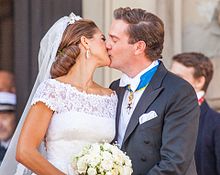
In mod Western culture, kissing on the lips is commonly an expression of amore[forty] or a warm greeting. When lips are pressed together for an extended period, normally accompanied with an embrace, it is an expression of romantic and sexual desire. The practice of kissing with an open mouth, to allow the other to suck their lips or move their natural language into their mouth, is called French kissing. "Making out" is oftentimes an adolescent's first experience of their sexuality and games which involve kissing, such every bit Spin the Bottle, facilitate the experience. People may buss children on the forehead to comfort them or the cheek or lips to show affection.
In modern Eastern culture, the etiquette vary depending on the region. In West Asia, kissing on the lips between both men and women is a common form of greeting. In S and East asia, it might oftentimes be a greeting between women, however, between men, it is unusual. Kissing a babe on the cheeks is a common form of amore. Nigh kisses betwixt men and women are on the cheeks and not on the lips unless they are romantically involved. And sexual forms of kissing between lovers encompass the whole range of global practices.
Kissing in films [edit]
The kickoff romantic osculation on screen was in American silent films in 1896, offset with the motion picture The Kiss. The kiss lasted 18 seconds and caused many to rail against decadence in the new medium of silent moving picture. Writer Louis Blackness writes that "it was the United States that brought kissing out of the Night Ages."[41] However, it met with severe disapproval past defenders of public morality, especially in New York. 1 critic proclaimed that "it is absolutely disgusting. Such things call for police force interference."[41]

Young moviegoers began emulating romantic stars on the screen, such as Ronald Colman and Rudolph Valentino, the latter known for ending his passionate scenes with a buss. Valentino also began his romantic scenes with women past kissing her hand, traveling up her arm, and then kissing her on the back of her neck. Actresses were often turned into stars based on their screen portrayals of passion. Actresses like Nazimova, Pola Negri, Vilma Bánky and Greta Garbo, became screen idols equally a result.
Eventually, the film industry began to prefer the dictates of the Production Code established in 1934, overseen past Will Hays and supported by the church[ which? ].[ commendation needed ] Co-ordinate to the new code, "Excessive and lustful kissing, lustful embraces, suggestive postures and gestures, are non to be shown."[41] Every bit a result, kissing scenes were shortened, with scenes cut away, leaving the imagination of the viewer to accept over. Under the code, actors kissing had to go along their anxiety on the ground and had to be either standing or sitting.[42]
The heyday of romantic kissing on the screen took place in the early audio era, during the Gilt Historic period of Hollywood in the 1930s and 1940s.[43] : scout Trunk language began to be used to supplement romantic scenes, particularly with the optics, a talent that added to Greta Garbo's fame. Author Lana Citron writes that "men were perceived as the kissers and women the receivers. Should the roles always be reversed, women were regarded equally vamps . . ."[42] Co-ordinate to Citron, Mae Due west and Anna May Wong were the only Hollywood actresses never to have been kissed on screen.[42] Amidst the films rated for having the most romantic kisses are Gone with the Air current, From Here to Eternity, Casablanca, and To Have and Have Non.[42]
Sociologist Eva Illouz notes that surveys taken in 1935 showed that "dear was the nearly important theme represented in movies. Similar surveys during the 1930s plant the 95% of films had romance as one of their plot lines, what film critics called "the romantic formula."[44]
In early Japanese films, kissing and sexual expression were controversial. In 1931, a director slipped a kissing scene past the censor (who was a friend), but when the film opened in a downtown Tokyo theater, the screening was stopped and the film confiscated. During the American occupation of Japan, in 1946, an American censor required a film to include a kissing scene. One scholar says that the censor suggested "we believe that even Japanese do something like kissing when they love each other. Why don't you lot include that in your films?" Americans encouraged such scenes to strength the Japanese to express publicly actions and feelings that had been considered strictly private. Since Pearl Harbor, Americans had felt that the Japanese were "sneaky", claiming that "if Japanese kissed in private, they should do information technology in public too."[45]
Non-sexual kisses [edit]

In some Western cultures it is considered good luck to kiss someone on Christmas or on New year's day'due south Eve, peculiarly beneath a sprig of mistletoe. Newlyweds usually kiss at the cease of a wedding ceremony.
Female friends and relations and close acquaintances commonly offer reciprocal kisses on the cheek as a greeting or goodbye.[46] Where cheek kissing is used, in some countries a unmarried kiss is the custom, while in others a kiss on each cheek is the norm, or even three or four kisses on alternating cheeks. In the Usa, an air kiss is becoming more mutual. This involves kissing in the air about the cheek, with the cheeks touching or non.[47] Afterwards a first date, it is common for the couple to requite each other a quick kiss on the cheek (or lips where that is the norm) on parting, to indicate that a good time was had and perchance to indicate an interest in some other meeting.
A symbolic buss is frequent in Western cultures. A buss can be "blown" to another by kissing the fingertips and then blowing the fingertips, pointing them in the management of the recipient. This is used to convey affection, unremarkably when parting or when the partners are physically distant just can view each other. Diddled kisses are also used when a person wishes to convey amore to a large crowd or audience. The term flying buss is used in Republic of india to draw a blown kiss. In written correspondence a buss has been represented past the letter "X" since at to the lowest degree 1763.[48] A stage or screen osculation may exist performed by actually kissing, or faked by using the thumbs every bit a barrier for the lips and turning so the audience is unable to fully see the act.
Some literature suggests that a meaning per centum of humanity does non kiss.[49] It has been claimed that in Sub-Saharan African, Asiatic, Polynesian and perhaps in some Native American cultures, kissing was relatively unimportant until European colonization.[50] [51] Historically however, the culture of kissing is idea to take begun and spread from the Eastern World, specifically Bharat.[35]
With the Andamanese, kissing was only used every bit a sign of affection towards children and had no sexual undertones.[52]
In traditional Islamic cultures, kissing is not permitted between a human and woman who are not married or closely related by blood or marriage. A osculation on the cheek is a very common course of greeting among members of the same sexual practice in nearly Islamic countries, much like the south European blueprint.
Legality of public kissing [edit]
![[icon]](https://upload.wikimedia.org/wikipedia/commons/thumb/1/1c/Wiki_letter_w_cropped.svg/20px-Wiki_letter_w_cropped.svg.png) | This section needs expansion. Y'all can assistance past adding to it. (March 2017) |
In 2007, two people were fined and jailed for a calendar month after kissing and hugging in public in Dubai.[53]
In Republic of india, public display of affection is a offense nether Section 294 of the Indian Penal Code, 1860 with a punishment of imprisonment of up to iii months, or a fine, or both. This police was used by police and lower courts to harass and prosecute couples engaging in intimate acts, such every bit kissing in public.[54] [55] All the same, in a number of landmark cases, the higher courts dismissed assertions that kissing in public is obscene.[56] [57]
In organized religion [edit]
Kissing was a custom during the Biblical flow mentioned in the Genesis 27:26, when Isaac kissed his son Jacob.[58] : 585 The kiss is used in numerous other contexts in the Bible: the kiss of homage, in Esther 5:2; of subjection, in 1 Samuel 10:1; of reconciliation, in 2 Samuel fourteen:33; of valediction, in Ruth 1:xiv; of approbation, in Psalms ii:12; of humble gratitude, in Luke seven:38; of welcome, in Exodus xviii:7; of love and joy, in Genesis 20:eleven. There are as well spiritual kisses, as in Song of Songs ane:2; sensual kisses, as in Proverbs 7:thirteen; and hypocritical kisses, as in 2 Samuel 15:5. It was customary to osculation the mouth in biblical times, and also the bristles, which is still proficient in Arab culture. Kissing the hand is not biblical, according to Tabor.[58] The buss of peace was an apostolic custom, and continues to be ane of the rites in the Eucharistic services of Roman Catholics.[58]
In the Roman Catholic Order of Mass, the bishop or priest celebrant bows and kisses the altar, reverencing it, upon arriving at the altar during the entrance procession before Mass and upon leaving at the recessional at the endmost of Mass; if a deacon is assisting, he bows low earlier the altar but does not osculation it.
Among archaic cultures it was usual to throw kisses to the sun and to the moon, as well as to the images of the gods. Kissing the paw is first heard of among the Persians.[58] According to Tabor, the kiss of homage—the character of which is not indicated in the Bible—was probably upon the brow, and was expressive of loftier respect.[58]

This woodcut of the practice of kissing the Pope'south toe is from Passionary of the Christ and Antichrist by Lucas Cranach the Elder.
- In Ancient Rome and some mod Pagan beliefs, worshipers, when passing the statue or epitome of a god or goddess, will osculation their hand and wave it towards the deity (admiration).
- The holy kiss or kiss of peace is a traditional part of most Christian liturgies, though ofttimes replaced with an embrace or handshake today in Western cultures.
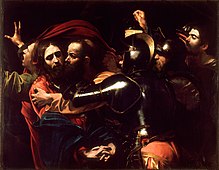
- In the gospels of Matthew and Mark (Luke and John omit this) Judas betrayed Jesus with a osculation: an instance of a kiss tainted with expose. This is the basis of the term "the osculation of Judas".
- Catholics will buss rosary beads equally a office of prayer, or kiss their hand later on making the sign of the cantankerous. It is also common to kiss the wounds on a crucifix, or any other image of Christ'due south Passion.
- Pope John Paul II would kiss the ground on arrival in a new country.
- Visitors to the Pope traditionally kiss his foot.
- Catholics traditionally kiss the ring of a cardinal or bishop.
- Catholics traditionally kiss the hand of a priest.
- Eastern Orthodox and Eastern Catholic Christians often kiss the icons around the church on entering; they will as well kiss the cross and/or the priest'south hand in certain other customs in the Church building, such as confession or receiving a blessing.
- Hindus sometimes osculation the floor of a temple.
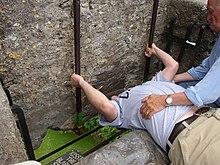
- Local lore in Ireland suggests that kissing the Blarney Stone will bring the gift of the gab.
- Jews will kiss the Western wall of the Holy Temple in Jerusalem, and other religious manufactures during prayer such equally the Torah, usually past touching their manus, Tallis, or Siddur (prayerbook) to the Torah and so kissing it. Jewish police prohibits kissing members of the contrary sex activity, except for spouses and sure shut relatives. Run across Negiah.
- Muslims may kiss the Black Rock during Hajj (pilgrimage to Mecca). Many Muslims also kiss Shrines of Ahlulbayt and Sufis.
Biology and evolution [edit]
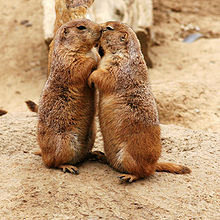
Within the natural world of other animals, there are numerous analogies to kissing, notes Crawley, such as "the billing of birds, the cataglottism of pigeons and the antennal play of some insects." Even among mammals such as the dog, cat and bear, similar beliefs is noted.[31] : 114
Anthropologists have not reached a conclusion every bit to whether kissing is learned or a beliefs from instinct. It may be related to grooming beliefs also seen between other animals, or arising as a issue of mothers premasticating food for their children. Non-human primates likewise exhibit kissing behavior.[60] [61] Dogs, cats, birds and other animals display licking, nuzzling, and grooming behavior among themselves, and also towards humans or other species. This is sometimes interpreted by observers as a blazon of kissing.
Kissing in humans is postulated to accept evolved from the direct oral cavity-to-mouth regurgitation of food (kiss-feeding) from parent to offspring or male person to female (courting feeding) and has been observed in numerous mammals.[62] The similarity in the methods between buss-feeding and deep human kisses (e.g. French kiss) are quite pronounced; in the former, the natural language is used to push nutrient from the mouth of the mother to the child with the child receiving both the mother's food and tongue in sucking movements, and the latter is the same but forgoes the premasticated food. In fact, through observations across various species and cultures, information technology can be confirmed that the human action of kissing and premastication has nearly likely evolved from the like human relationship-based feeding behaviours.[62] [63]
Physiology [edit]
Kissing is a circuitous beliefs that requires pregnant muscular coordination involving a total of 34 facial muscles and 112 postural muscles.[64] [65] The most important musculus involved is the orbicularis oris muscle, which is used to pucker the lips and informally known every bit the kissing muscle.[66] [67] In the case of the French osculation, the tongue is also an important component. Lips have many nervus endings which make them sensitive to impact and seize with teeth.[68]
Health benefits [edit]
Kissing stimulates the product of hormones responsible for a adept mood: oxytocin, which releases the feeling of love and strengthens the bond with the partner, endorphins – hormones responsible for the feeling of happiness –, and dopamine, which stimulates the pleasure centre in the brain. Regular kissing protects against depression.[69] Affection in general has stress-reducing effects. Kissing in particular has been studied in a controlled experiment and it was found that increasing the frequency of kissing in marital and cohabiting relationships results in a reduction of perceived stress, an increase in relationship satisfaction, and a lowering of cholesterol levels.[70]
Affliction transmission [edit]
Kissing on the lips can issue in the transmission of some diseases, including infectious mononucleosis (known every bit the "kissing disease") and canker simplex when the infectious viruses are nowadays in saliva. Research indicates that contraction of HIV via kissing is extremely unlikely, although at that place was a documented instance in 1997 of an HIV infection by kissing. Both the woman and infected human had gum disease, and so transmission was through the human'due south blood, not through saliva.[71]
See also [edit]
- Eskimo kissing
- Mitt-kissing
- Hugs and kisses
- Kissing games
- Kissing traditions
- Kissing booth
References [edit]
- ^ Waal, Frans B. M. De. "Bonobo Sex and Gild". Scientific American . Retrieved 2022-05-02 .
- ^ "The (Generally) Blissful History of 'Kissing'". NPR.org . Retrieved 2022-05-02 .
- ^ published, Kristina Fiore (2013-02-02). "Why Practice People Buss?". livescience.com . Retrieved 2022-05-02 .
- ^ Hogenboom, Melissa. "Why do humans kiss each other when well-nigh animals don't?". www.bbc.com.
- ^ [i] Archived 2014-12-04 at annal.today
- ^ Kramer, Samuel Noah (1981). History Begins at Sumer (3rd revised. ed.). Philadelphia: University of Pennsylvania Press. pp. 72ff. ISBN978-0-8122-1276-1.
- ^ The Electronic Text Corpus of Sumerian Literature Faculty of Oriental Studies, Academy of Oxford
- ^ "Ancient Poetry". TheMagentaHornet.com.
- ^ "Egyptian Dearest Poesy from the New kingdom". www.love-poetry-of-the-globe.com.
- ^ Hess, Richard South. Song of Songs, Baker Academic (2005) p. 48
- ^ "Song of Solomon 1:2, Bible Hub, Biblos
- ^ Xenophon, Cyropaedia, 1.4.27 Archived 2016-02-06 at the Wayback Machine
- ^ electricpulp.com. "HERODOTUS iii. DEFINING THE PERSIANS – Encyclopaedia Iranica". world wide web.iranicaonline.org.
- ^ "Internet History Sourcebooks". legacy.fordham.edu. Archived from the original on 2015-11-29. Retrieved 2016-01-03 .
- ^ "Archived copy". Archived from the original on 2014-12-08. Retrieved 2014-12-04 .
{{cite web}}: CS1 maint: archived copy as championship (link) - ^ Jones, Terry "The Aboriginal World According to Terry Jones (Love and Sex)" (1998)
- ^ "The science of kissing", CNN, Feb. 14, 2012
- ^ "Chemical attraction: The science of kissing" Archived 2013-08-23 at the Wayback Machine, Medill Reports, Feb. 14, 2009
- ^ a b c d eastward f m h i j k l m n o p q r s Nyrop, Kristoffer. The Osculation and its History, Sands & Co., London (1901) Read full text
- ^ Dyer, Tristeleton T.F. "The History of Kissing", The American Magazine, vol. fourteen 1882, pp. 611–614
- ^ a b c Brayer, Menachem M. The Jewish Woman in Rabbinic Literature, KTAV Publishing House (1986)
- ^ Halpern, Carolyn Tucker; Joyner, Kara; Udry, J.Richard; Suchindran, Chirayath (2000). "Smart teens don't have sex (or kiss much either)". Periodical of Adolescent Health. 26 (three): 213–25. doi:10.1016/S1054-139X(99)00061-0. PMID 10706169.
- ^ William Smith, Smith's Bible Dictionary, Buss, United kingdom, 1988
- ^ a b Marine Gasc, racontemoilhistoire.com, Le bisou, France, January xx, 2016
- ^ Yannick Carré, Le baiser sur la bouche au Moyen Âge : rites, symboles, mentalités, à travers les textes et les images, XIe-XVe siècles, Le Léopard d'Or, 1992, folio 357
- ^ Eric Anderson, Adi Adams, Ian Rivers, Archives of Sexual Behavior "I Kiss Them Considering I Beloved Them": The Emergence of Heterosexual Men Kissing in British Institutes of Education, United kingdom of great britain and northern ireland, Apr 2012, Volume 41. 2, pages 421–430
- ^ Journal 7sur7.exist, Nouvelle tendance: des bisous sur la bouche entre amis!, Kingdom of belgium, October 29, 2010
- ^ a b c d e Cane, William. The Art of Kissing, Macmillan (1991)
- ^ Hopkins, Eastward. Washbun (1907). "The Sniff-Osculation in Aboriginal Bharat". Journal of the American Oriental Society. American Oriental Guild. 28: 120–134. doi:10.2307/592764. JSTOR 592764. Retrieved 25 January 2021.
- ^ Kuraweil, Arthur.The Torah for Dummies, Wiley Publishing (2008) p. 218
- ^ a b c d Crawley, Ernest. Studies of Savages and Sex, Kessinger Publishing (revised and reprinted) (2006)
- ^ The (By and large) Blissful History of Kissing, NPR February 11, 2007
- ^ "In India, Kisses Are on Ascent, Fifty-fifty in Public", New York Times, Feb. 13, 2013
- ^ "Bollywood well-nigh passionate kisses of all times".
- ^ a b Patel, Atish (1 Nov 2014). "A Brusque History of the Osculation in Bharat".
- ^ "When a Kiss Is More Than a Buss", The New York Times, May. 6, 2007
- ^ Donald Richie, "The Japanese Kiss," in Donald Richie, ed., Walkman, Manga, and Society: Essays on Contemporary Japanese Civilisation (Tokyo: Kirihara shoten, 1989), 52–58.
- ^ Shirokogorov, Sergeĭ Mikhaĭlovich (1924). Social Organization of the Manchus: A Written report of the Manchu Association Organization. Majestic Asiatic Gild. p. i, 1–6, 122.
- ^ Robert Hans van Gulik (1974). A Preliminary Survey of Chinese Sex activity and Social club from Ca. 1500 B.C. Till 1644 A.D. Brill Annal. p. 49. ISBN9789004039179.
- ^ James, Larry (4 March 2008). "The Romantic Osculation". The Zambian Relate. Archived from the original on 21 June 2008. Retrieved 29 August 2008.
- ^ a b c Texas Monthly, Feb. 1980 p. 143
- ^ a b c d Citron, Lana. A Compendium of Kisses, Harlequin Publ. (2010) p. 177
- ^ video: Kissing scenes in the classic movies
- ^ Illouz, Eva. Consuming the Romantic Utopia, Univ. of Calif. Press (1997) p. 31
- ^ Kyoko Hirano, Mr. Smith Goes to Tokyo: The Japanese Cinema under the American Occupation, 1945–1952 (Washington, DC: Smithsonian Institution, 1992), pp 154–57, 162
- ^ Olson, Elizabeth (6 April 2006). "Better Non Miss the Buss". The New York Times . Retrieved 29 August 2008.
- ^ Hahnsson, Marie Sophie. "Cheek Kissing". University of Oslo. Archived from the original on 27 May 2008. Retrieved 29 Baronial 2008.
- ^ "Oxford English language Lexicon – 10". Oxford University printing. 1999. Retrieved 1 February 2007.
- ^ "Affairs of the Lips: Why Nosotros Kiss: Scientific American". Sciam.com. 31 January 2008. doi:x.1038/scientificamericanmind0208-24. Retrieved 28 March 2010.
- ^ Thomas, Keith (eleven June 2005). "Put your sweet lips..." The Times. London. Retrieved 25 May 2008.
- ^ Marvin Chiliad. Opler, "Cross-cultural aspects of kissing", Medical Aspects of Man Sexuality, Vol. 3, No. ii, February 1969, pp. 11, 14, 17, twenty–21]
- ^ "Affiliate: 9: A Traditional Society". Andaman.org. Archived from the original on 15 March 2010. Retrieved 28 March 2010.
- ^ McGreevey, Ronan (March 17, 2007). "Don't osculation the girlfriend in Dubai, don't affluent a Swiss loo afterwards 10pm and, whatsoever yous do, don't insult the Thai king". Irish Independent.
- ^ Sengupta, Somini (January 4, 2006). "Is Public Romance a Correct? The Kama Sutra Doesn't Say". The New York Times . Retrieved October 16, 2010.
- ^ "Israelis fined for wedding ceremony osculation". BBC News. September 21, 2005. Retrieved October 16, 2010.
- ^ "India Couple's osculation 'not obscene'". BBC News. February three, 2009. Retrieved October 16, 2010.
- ^ "Richard Gere cleared of obscenity". BBC News. March 14, 2008. Retrieved October 16, 2010.
- ^ a b c d e Tabor, Rev. T.H. Manford's Magazine (1888)
- ^ "Prairie Dog, cynomys ludovicianus". 2014. Retrieved July 26, 2014.
- ^ "How animals buss and make up". BBC News. October xiii, 2003.
- ^ "Chimp Facts - Jane Goodall Constitute UK". www.janegoodall.org.uk . Retrieved 2018-12-08 .
- ^ a b Eibl-Eibesfeldt, Irenäus (1971). "Love and hate: the natural history of behavior patterns". Aldine Transaction.
- ^ Eibl-Eibesfeldt, Irenäus (1983). "Chapter three: A comparative arroyo to human ethology". In Rajecki, D. W. (ed.). Comparing behavior: studying man studying animals. Routledge.
- ^ Blue, Adrienne (ane June 1996). "The kiss". The Independent (London). Archived from the original on 23 December 2008. Retrieved 29 August 2008.
- ^ Highfield, Roger (17 October 2006). "Seal with..146 muscles". The Telegraph. London. Archived from the original on 26 October 2006. Retrieved 29 August 2008.
- ^ "orbicularis oris musculus". TheFreeDictionary: Mosby's Dental Dictionary, 2d edition. 2008. Retrieved 3 October 2010.
- ^ "Muscles – Facial". BBC: Science & Nature: Human Body & Mind. Retrieved 3 Oct 2010.
- ^ Conis, Elena (4 Feb 2008). "The mystery of the kiss". Los Angeles Times . Retrieved seven May 2010.
- ^ "jak sie całować". pense.pl. 2019-01-06.
- ^ Floyd, Kory; Boren, Justin P.; Hannawa, Annegret F.; Hesse, Colin; Breanna McEwan; Alice E. Veksler (ii April 2009). "Kissing in Marital and Cohabiting Relationships: Effects on Blood Lipids, Stress, and Relationship Satisfaction". Western Journal of Communication. Informaworld.com. 73 (2): 113–133. doi:10.1080/10570310902856071. hdl:11123/502. S2CID 73634219.
- ^ Altman, Lawrence K. (11 July 1997). "Instance of H.I.V. Transmission Is Commencement to Be Linked to Kiss". New York Times . Retrieved 28 March 2010.
Farther reading [edit]
- Kirshenbaum, Sheril (2011). The Scientific discipline of Kissing: What Our Lips Are Telling Us. 1000 Central Publishing. ISBN978-0-446-55990-4.
- Beadnell,C. M. (1942) The Origin of the Kiss , Thinkers Library No.89, Watts & Co, London
External links [edit]
 | Wikiquote has quotations related to Kissing . |
 | Wikimedia Commons has media related to Kissing. |
- . Encyclopædia Britannica. Vol. 15 (11th ed.). 1911.
- Kissing in Strange Places Archived 2012-01-05 at the Wayback Auto — slideshow by Life mag
- Put your sugariness lips... (A history of the kiss), Keith Thomas, The Times, June eleven, 2005
- The Buss of Life, Joshua Foer, The New York Times, February 14, 2006
- Why do humans kiss each other when most animals don't?, Melissa Hogenboom, BBC Earth, July 2015
- How Kissing Works, History and Beefcake of the Kiss, Tracy Five. Wilson, HowStuffWorks
hemingwayapereens1993.blogspot.com
Source: https://en.wikipedia.org/wiki/Kiss

Post a Comment for "I Kiss Him Again and I Feel Like I m Flying"